a non-profit U.S. organization bridging Greece and the USA since 1989, through tourism, culture, and strategic partnerships. Explore our mission, connect and become part of a dynamic community.
A conversation with John Daskalakis, Founder of Rízes Hellenic Genealogy Research
@RízesGen — Hellenic Genealogy Research
"Genealogy sits at the center of this process. It is not just about names and dates. It is about reconnecting people with their history and helping them understand where their story began."
Tell us a few words about yourself.
I grew up in the New York City metropolitan area, and my paternal family roots are in Crete. My father was born in the village of Kaina in the Apokoronas region of Chania, and our family lines extend throughout the area, including the communities of Vamos and Georgioupoli. Through my paternal grandmother’s side, my family tree extends into Sfakia and connects to the lineage of Daskalogiannis. My paternal grandfather’s family comes from Kokkini Hani near Heraklion.
On my maternal side, my family roots are in the Piraeus region of Athens. My mother was born in Korydallos, while my maternal grandfather’s family comes from Palaia Kokkinia with extended family ties to Egaleo. My maternal great-grandfather originally came from Kranidi in Argolis in the Peloponnese, with earlier family connections to the region of Epirus. My maternal grandmother was born in Agia Marina in the Dodecanese. Through my maternal grandmother’s father, my family also has ties to Zakynthos leading to the Greek national poet Dionysios Solomos. Through her mother’s side our family roots also extend to Aegina, Kalymnos, Kefalonia, and Crete.
Growing up with stories about these places and the people connected to them sparked my curiosity about genealogy and the deeper history of families.
What is Rízes, what does genealogy mean to you, and how did you decide to create them?
When I was a child, I originally wanted to become an architect because I loved designing buildings with my Legos. Around this time, I would occasionally hear unclear family stories about possible connections to Daskalogiannis and Dionysios Solomos, but as a kid I didn’t pay much attention to them.
As I got older, my interests shifted toward history and writing. My idea of becoming an architect gradually changed as I realized I was far more interested in learning about the history behind the structures of Ancient Greece. I also quickly discovered that the level of mathematics required for architecture was not exactly where my interests were. During my freshman year of high school, I decided that I wanted to live up to the family name and work as an educator with a background in technology. Over the years I taught a variety of subjects ranging from Pre-K classes to middle school English Language Arts, history, and several computer courses after school. Eventually I was contacted by Microsoft and began working as their Education Expert for the Long Island region, a position I held until the beginning of the COVID pandemic.
Long before working at Microsoft, I had taken a DNA test, but like many people I eventually forgot about it. About a year or two before COVID I began exploring genealogy more seriously as a pastime. During that time, I started connecting with cousins across the United States, including relatives in Massachusetts, Florida, Texas, Utah, California, and Arizona.
As COVID approached, my research began to attract more attention and I slowly started to develop a reputation within both the professional genealogical community and the Greek genealogical communities on Facebook and Instagram. I joined organizations such as the Association of Professional Genealogists and the National Genealogical Society, and I also began working on larger research projects such as the historical study of the Forakis family while continuing to refine my research skills.
During this time, I also began creating research communities of my own, including groups such as the Descendants of Utah’s Greek Miners group and the Greeks of Chicago Genealogy group. Members of these communities often began asking me to help dig deeper into their own family histories because they saw the depth of my research and investigative work.
One day I began hearing rumblings that my position at Microsoft might be dissolved worldwide, and I realized I needed to think quickly about what my next step would be. At the time I was in my mid-forties and understood that starting over in a completely new field would not be easy. Around that same period, I had already begun receiving a great deal of encouragement for my work in genealogy. Many members of the Facebook communities where I shared my research were telling me that one day I should consider doing genealogical research professionally after I retired from Microsoft.
One evening in mid-February I sat down and seriously considered my options. I knew I was not about to start over as a substitute teacher late in the school year. My choices seemed clear: either continue working as a technology trainer or take several months off and formally train to become a professional genealogist. I chose the latter.
I decided to combine everything I had learned over the years, my background in education, technology, history, and research, and use those skills to build something new. From that decision, Rízes Hellenic Genealogy Research was born.
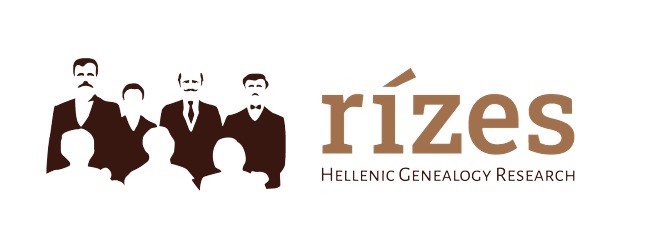
I chose the name "Rízes" very intentionally. I had seen many genealogy logos that relied on large green trees, and I knew I did not want to repeat the same imagery. At the same time, I also wanted to avoid the typical Greek visual clichés such as columns or temple motifs, which are often used in restaurant branding here in New York. Instead, I focused on the genealogical meaning of the word "roots", the origins of a family and the places where their story begins. Using the English phrase "Roots Genealogy" did not feel distinctive enough, especially for a Greek-focused research initiative. The Greek word "Rízes" immediately captured both meanings: the genealogical concept of roots and the cultural connection to Greece.
As a personal detail, the logo itself also reflects my own family history. The figures at the top represent earlier generations, and two of them are modeled after real ancestors, my paternal grandfather and a maternal fourth great-grandfather. Interestingly, that fourth great-grandfather remains one of the "missing links" in my own research, a reminder that even genealogists continue searching for answers within their own family stories.
Would you say there has been increased interest among Greeks of the diaspora in discovering their roots?
In my experience, the interest in genealogy among Greeks of the diaspora has grown tremendously in recent years. I have been able to observe this firsthand through the research communities I help lead and through the many individuals who contact me looking for answers about their family history.
What I see most often falls into two general groups. The first group consists largely of third and fourth generation Greek Americans who feel that something important was lost when their grandparents or great-grandparents arrived in the United States. In many cases, the immigrant generation felt pressure to fully assimilate into American society and to set aside their language and aspects of their cultural identity. As a result, many descendants today feel a strong desire to reconnect with that missing part of their heritage.
The second group I encounter consists of first-generation Greeks living abroad who are thinking about the future of their families. They want their children and grandchildren to maintain a connection with Greek culture, history, and language, even if they grow up outside of Greece.
Social media has played an important role in this cultural rediscovery. Today we see historians, genealogists, language teachers, translators, home cooks, professional chefs, and influencers sharing Greek culture across platforms that reach people all over the world.
For me, genealogy sits at the center of this process. It is not just about names and dates. It is about reconnecting people with their history and helping them understand where their story began. As the slogan for Rízes says, it is about being "rooted in history and growing your legacy."
Where does entrepreneurship begin and end when dealing with something as sensitive as a person’s roots?
When we speak about genealogy, entrepreneurship must always be balanced with responsibility. A genealogist is not simply providing a service in the way many other professions do. We are working with something far more personal: a family’s history, identity, and memory.
In life there are only a few professionals who truly come to know you on a personal level. A doctor understands your physical health, a psychologist or therapist understands your emotional life, and even something as simple as a barber often becomes someone you speak with regularly about the events of your life.
In a similar way, a genealogist becomes someone who learns the deeper story of your family. People often share memories, family traditions, photographs, and long-held stories about their relatives. The genealogist then takes all of these pieces and begins to assemble the larger picture, discovering where certain traits, family features, migrations, and traditions may have originated.
In many ways, your genealogist becomes something like the best friend you never knew you had. Who else truly gets to know your family history at that level?
This is why genealogy must always be practiced with respect, honesty, and care. The work is not simply about documents or historical records. It is about helping people understand their place in a much larger story that began generations before them.
Hospitality or tourism?
When I was about sixteen or seventeen years old, I traveled to Greece for the first time in the mid-1990s. One of the memories that has stayed with me ever since was visiting the apartment building in Egaleo where my maternal grandmother once lived.
I remember carefully looking around the building, walking on the same floors she had once walked on, and even touching the doorknob to her apartment. As I stepped inside, dust floated through the air and I could almost feel the presence of the life she once lived there.
The last time I saw my grandmother I was less than two years old, and one of my clearest childhood memories of her was sitting at the table while she fed me papara: stale bread with crushed tomatoes, olive oil, salt, pepper, and oregano. Standing in her living room and bedroom years later as a teenager was an emotional experience unlike anything I had ever felt before.
Shortly afterward I arrived at my paternal grandfather’s village in Crete for the first time. I remember walking along the dirt roads and while I was looking down it reminded me of a John Wayne western movie, it was only missing the tumbleweeds. When I walked into my paternal grandfather’s house, I was immediately greeted by my paternal grandmother.
Seeing the ancient structure of my grandparents’ home and realizing the differences between that life and the modern city was mind-blowing to me.
Less than twenty-four hours earlier I had been in the middle of a city, and suddenly I was standing in a place that represented generations of my family’s island roots.
Experiences like this are why I often say that when members of the Greek diaspora travel to Greece to discover their family roots, they are not really tourists. They are reconnecting with places that are part of their own story.
What they experience is something much closer to the ancient Greek idea of φιλοξενία, a sense of welcome, belonging, and shared history.
For many people, these journeys become more than a visit.
They become a return.
John Daskalakis
Founder, Rízes Hellenic Genealogy Research (RízesGen)